
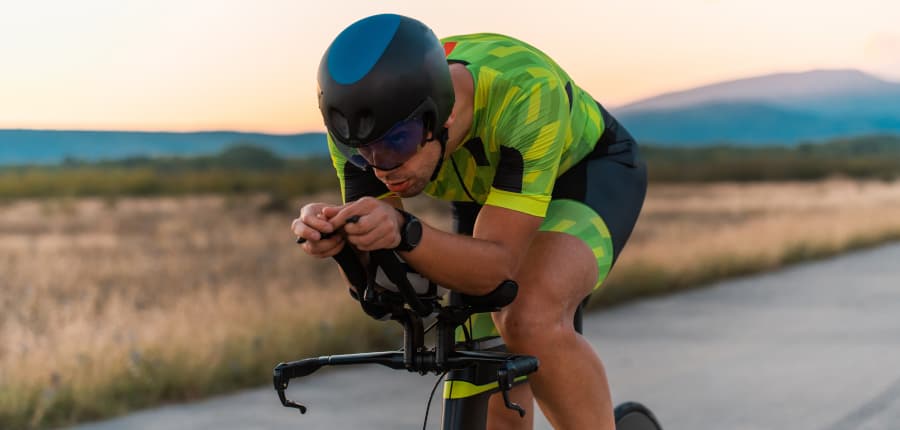
A full triathlon (Ironman) is seen by many as the ultimate challenge. Three sports: 3.8km swimming, 180km cycling, and a marathon. How far in advance should you start training to complete your ultimate challenge, and how many hours per week should you train? For most athletes, it should be possible to train for a full triathlon within a year. Of course, it becomes easier if you already have experience in one of the sports and are reasonably fit. In this article, I explain what is needed to complete a full triathlon.
What is the minimum performance level to complete a full triathlon?
To complete a full triathlon, you need a certain level of base fitness. With sheer willpower, you might be able to complete a triathlon at a snail's pace, but that is not the goal of the event. There are often specific time limits that you must meet to continue the triathlon. So, you need to have good fitness to complete the swimming, cycling, and running sections within the time limit. Each section has a separate time limit.
In many full triathlons, you must finish the entire event within approximately 16 hours. This can vary by event. After a year of serious training, the time limits should not be an issue. Towards the end of the triathlon, the mental aspect also plays a role, as it is normal to become fatigued when performing for such a long time.
How many hours per week do you need to train to complete a full triathlon?
Athletes preparing for their first full triathlon often wonder how many hours per week they need to train. With just a few training sessions per week, it is not possible to exercise for 10-14 hours continuously. Therefore, you need to be able to train a certain volume over an extended period. It is possible to finish your first triathlon with around ten hours of training per week. If you aim for a fast time, you will need to invest more hours per week, but that is not the goal of your first full triathlon.
For most athletes, running and cycling are quite flexible. In the morning, before work or studies, you can fit in a running session. A short run during your break is also often possible. If you can commute by bike, that also saves a lot of time. Many people take a detour to add extra kilometres.
Swimming is often the least flexible discipline to train. You are always dependent on the opening times of the local swimming pool. A morning session can save you a lot of time, but at some pools, these times are very busy.
How well do you need to swim for a full triathlon?
For most people, the swimming section is the most challenging to train for. Not everyone masters the front crawl, so it may be a good idea to take a front crawl course before starting training for the full triathlon. Such a course teaches you the basic skills, ensuring that you can complete a swim session properly.
The swimming section is often underestimated by triathletes. You won’t win a triathlon during the swim, but you can certainly lose it there. Swimming as efficiently as possible, including using your legs, ensures that you waste less energy during the first part of the triathlon. You will need that energy later during the run to finish the triathlon. For a beginner triathlete, it is not as important to focus on periodisation and intervals in swim training. Instead, improving technique to swim as efficiently as possible is key. Two swim sessions per week can take you a long way.
Cycling training for a triathlon to improve endurance
In general, cycling training will take up the most time. This is also the section that takes the longest to complete. It is advisable to complete a few 180km rides before your triathlon. A long ride and two shorter sessions are manageable for most beginner triathletes. As you approach your triathlon, you can significantly increase your long rides. Extending the long sessions means that you will occasionally exceed ten hours of training per week.
To improve your cycling fitness, it is important to train at the right intensity. You want to maximise your aerobic base and fat metabolism. This requires training at a sufficiently low intensity. Combining this with higher-intensity intervals helps increase your cycling speed.
It is essential for beginner triathletes to build up cycling training gradually. You cannot suddenly start riding very long distances. It is also important to be comfortable on your bike, and a proper bike fit can be extremely helpful in achieving this.
Marathon training to successfully complete a full triathlon
Everyone can run, yet this is often where things go wrong. Running is highly injury-prone, and you can sustain injuries both during the triathlon and while training for it. Most people need to build up their running very gradually. Start with short distances at very low intensity. Initially, this may just be jogging. If you are patient, you will notice that you gradually become slightly faster. Technique drills can also help you run more efficiently.
When starting with running, it is better to do multiple very short sessions per week rather than longer, intense sessions. Running for 20 to 30 minutes at an easy pace is an excellent training approach. These sessions are also easy to fit in before or after work or studies. Eventually, you will need to include longer runs, as a marathon is no small feat. You should have completed at least a few 30km runs before starting your full triathlon. Ideally, you would already have marathon experience.
Think about the psychology of the sport
Training for a full triathlon is no small feat. It is possible to combine it with family life or a busy job or studies, but it is important to plan your training well. You won't benefit from filling in gaps in your schedule with training sessions every week. A fixed, pre-planned schedule ensures that you also find the mental space to complete a session.
The hard work required for your first triathlon is not the only challenge. The race day itself is also a test. It is a long day, and fatigue will accumulate significantly. Physically, most people are capable of completing a full triathlon, but as the kilometres add up, the mental aspect becomes increasingly important. Especially towards the end of the cycling leg and during the run, there will be moments when you struggle mentally.
How do you start training for a full triathlon?
Are you ready to take on the challenge? You will naturally want to know the best way to start training for a full triathlon. First, find out which full triathlon you would like to participate in and when it takes place. For many Ironman events, it is wise to register well in advance. Also, make a plan for yourself to determine when you might have time to train.
If you are training for a full triathlon, it is advisable to work with a coach. A triathlon coach can help you understand what is required in terms of training to complete your first triathlon. Additionally, they can be someone to answer your questions, encourage you, and keep you from overtraining.
You may also choose to train for a local short-distance triathlon first to see if you enjoy it.
