
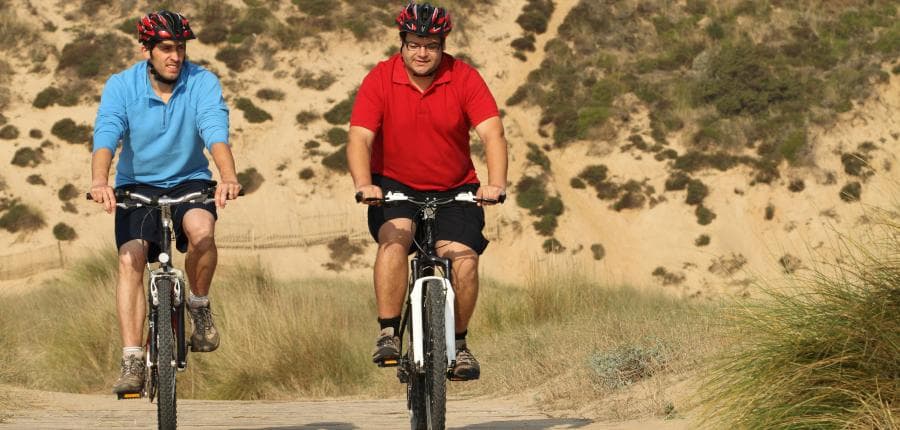
Cycling is an ideal sport that can help you lose weight, as you burn a lot of calories while riding. However, despite cycling frequently, you may find it difficult to shed those extra kilos. You might be wondering what you're doing wrong. You're certainly not alone in this. This issue isn't limited to elite athletes looking to lose half a kilo, but also affects individuals who are significantly overweight and want to slim down. With the right adjustments to your diet and training, you can lose those unwanted kilos. Here’s what you need to know:
What is needed to lose weight?
It’s very simple: you need to burn more calories than you consume. When you burn more calories by cycling, you will start losing weight. Therefore, it’s essential to know how much energy you burn during cycling so you can adjust your diet accordingly. On training days, you burn more energy and thus need to eat more than on rest days. Cyclists who train with a power meter have an advantage, as power is essentially a measure of how much energy you produce per second. Your bike computer accurately tracks how much energy you produce during your total training session. For professional cyclists, nutritionists can estimate their energy expenditure during a race and design a meal plan accordingly. After the race, the nutritionist analyses the data and adjusts the meal plan if necessary.
Cyclists often eat too little when trying to lose weight
You train a lot and watch your diet, yet the scales don’t budge. You’re not losing weight and may even be gaining. I have worked with many athletes over the years and see this problem frequently. Most of the time, I advise these athletes to eat more, and then they start losing weight again. If you consume far too little energy due to a strict diet or because you burn so much energy while cycling that you can’t keep up with eating enough, your metabolism slows down.1 The amount of energy burned during cycling can be very high. In an endurance training session of 1.5 to 2 hours, you can burn around 500-1000 kcal, and your body also requires energy for basic metabolic functions such as breathing, digestion, and temperature regulation. Even if you aim to lose weight, you still need to consume a considerable amount of energy. A personalised meal plan tailored to your training sessions can help you reach your target weight.
Weight loss should not compromise your training
If you consume less energy than you need, it can negatively impact your training sessions. The last thing you want is to struggle through a workout because you haven’t eaten enough, leading to the infamous 'bonk'. Training quality is crucial for improvement; if you lack energy for your intervals, you won’t make progress. It’s essential to eat enough before and during training. To lose weight through cycling, your nutrition must be well-balanced with your training sessions. Carbohydrates are the most important fuel for athletes, and a low-carb diet can negatively impact performance. When training intensity is high, your muscles rely on carbohydrates. While you want to consume fewer calories than you burn to lose weight, you still need to ensure your muscles have enough carbohydrates for training.
Training on an empty stomach won’t help you lose weight
Many people believe that fasted training helps with weight loss. The idea is that training before breakfast burns fat. However, this is not entirely true. After an overnight fast, your liver’s carbohydrate stores are depleted, but your muscle glycogen stores remain full if you had a normal meal the evening before. Your body will first burn muscle glycogen before switching to fat burning. Additionally, weight loss is not about fat burning alone; you must burn more energy than you consume. If you train before breakfast, you start the day with a significant energy deficit, increasing the risk of excessive hunger later in the day, leading to unintended overeating and consuming more energy than you burn.
Avoid muscle loss when trying to lose weight
When you consume fewer calories than you burn, you lose weight. Around 70-80% of that weight loss is fat mass, but 20-30% is lean mass, mainly muscle.2 If you are significantly overweight, losing some muscle mass is not necessarily harmful from a health perspective. However, for performance-driven athletes looking to lose weight, preserving muscle mass is crucial.3 You can minimise muscle loss by adjusting your meal composition. A larger portion of your diet should consist of protein. Typically, about 15% of your diet consists of protein, with the rest coming from fats and carbohydrates. Increasing this to 25-30% can help maintain muscle mass while losing weight.4 5
What cycling workouts are best for weight loss?
When it comes to weight loss, it’s all about energy expenditure. The term 'fat burning' is often misunderstood, leading to confusion. If you are overweight, your goal is to lose stored fat mass—excess energy stored in your body. It doesn’t matter where the energy you burn comes from; as long as you burn more energy than you consume, you’ll lose weight. You don’t need to train exclusively at low intensity just because your body primarily uses fat for energy at lower intensities. A balanced combination of different training forms is essential for improving fitness, including both low-intensity endurance rides and high-intensity interval sessions. To improve your fitness, it’s important to maintain a balanced training approach. A personalised training plan can help with this.
1. Mountjoy M, Sundgot-Borgen JK, Burke LM, et al. IOC consensus statement on relative energy deficiency in sport (RED-S): 2018 update. Br J Sports Med. 2018;52(11):687-697. https://doi.org/10.1136/bjsports-2018-099193
2. Weinheimer EM, Sands LP, Campbell WW. A systematic review of the separate and combined effects of energy restriction and exercise on fat-free mass in middle-aged and older adults: implications for sarcopenic obesity. Nutr Rev. 2010;68(7):375-388. https://doi.org/10.1111/j.1753-4887.2010.00298.x
3. Churchward-Venne TA, Murphy CH, Longland TM, Phillips SM. Role of protein and amino acids in promoting lean mass accretion with resistance exercise and attenuating lean mass loss during energy deficit in humans. Amino Acids. 2013;45(2):231-240. https://doi.org/10.1007/s00726-013-1506-0
4. Krieger JW, Sitren HS, Daniels MJ, Langkamp-Henken B. Effects of variation in protein and carbohydrate intake on body mass and composition during energy restriction: a meta-regression 1. Am J Clin Nutr. 2006;83(2):260-274. https://doi.org/10.1093/ajcn/83.2.260
5. Wycherley TP, Moran LJ, Clifton PM, Noakes M, Brinkworth GD. Effects of energy-restricted high-protein, low-fat compared with standard-protein, low-fat diets: a meta-analysis of randomized controlled trials. Am J Clin Nutr. 2012;96(6):1281-1298. https://doi.org/10.3945/ajcn.112.044321
